Maritime Lighthouse

Free · macOS · v0.4.0

Maritime Lighthouse

Pixel lighting control that runs on a laptop and nothing else.

A standalone Mac app that drives pixel fixtures over sACN and Art-Net. Its own render engine, its own cue stack, and an output monitor that shows you every DMX channel actually going out the wire. No server, no broker, no internet.

Lighthouse — Cues
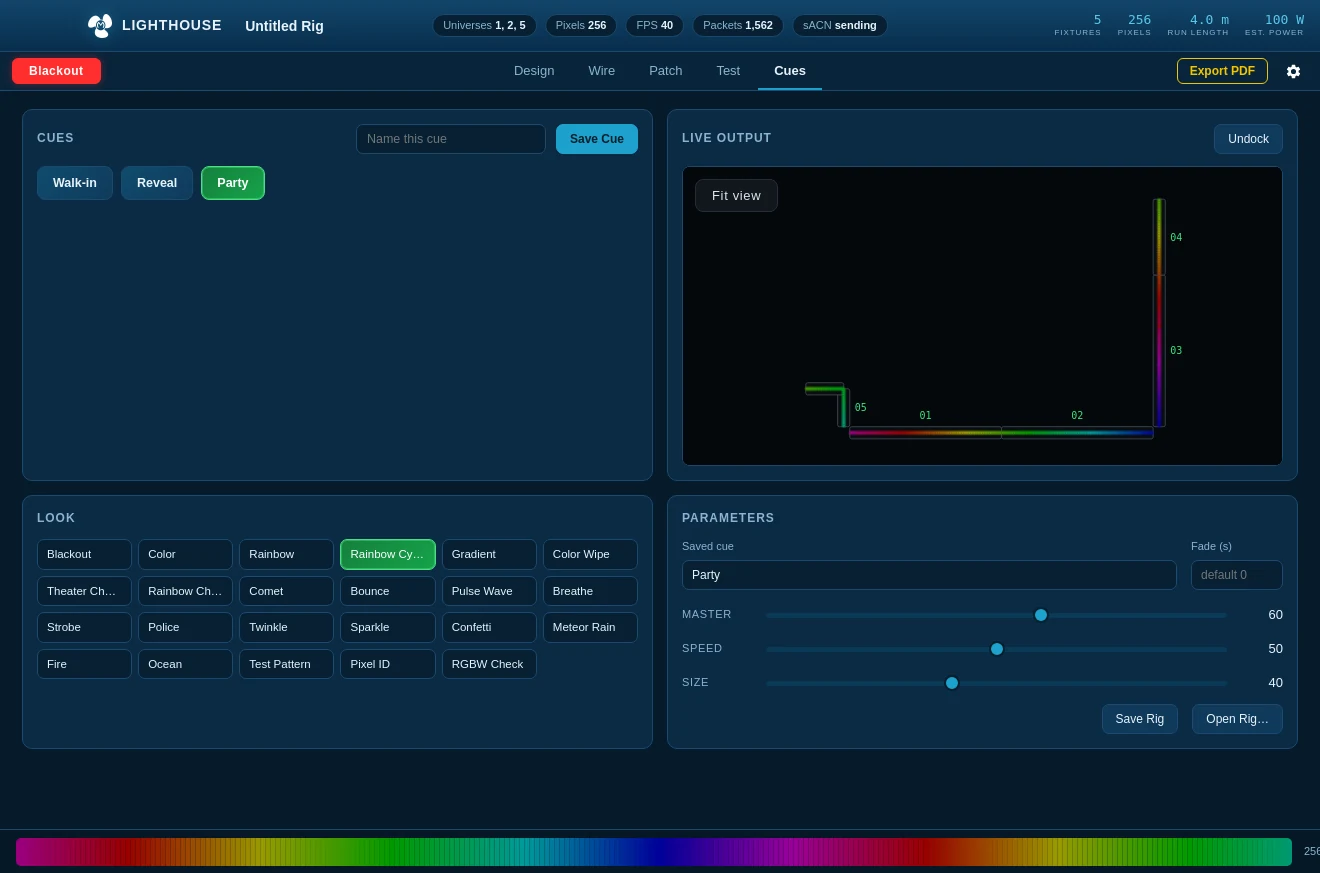
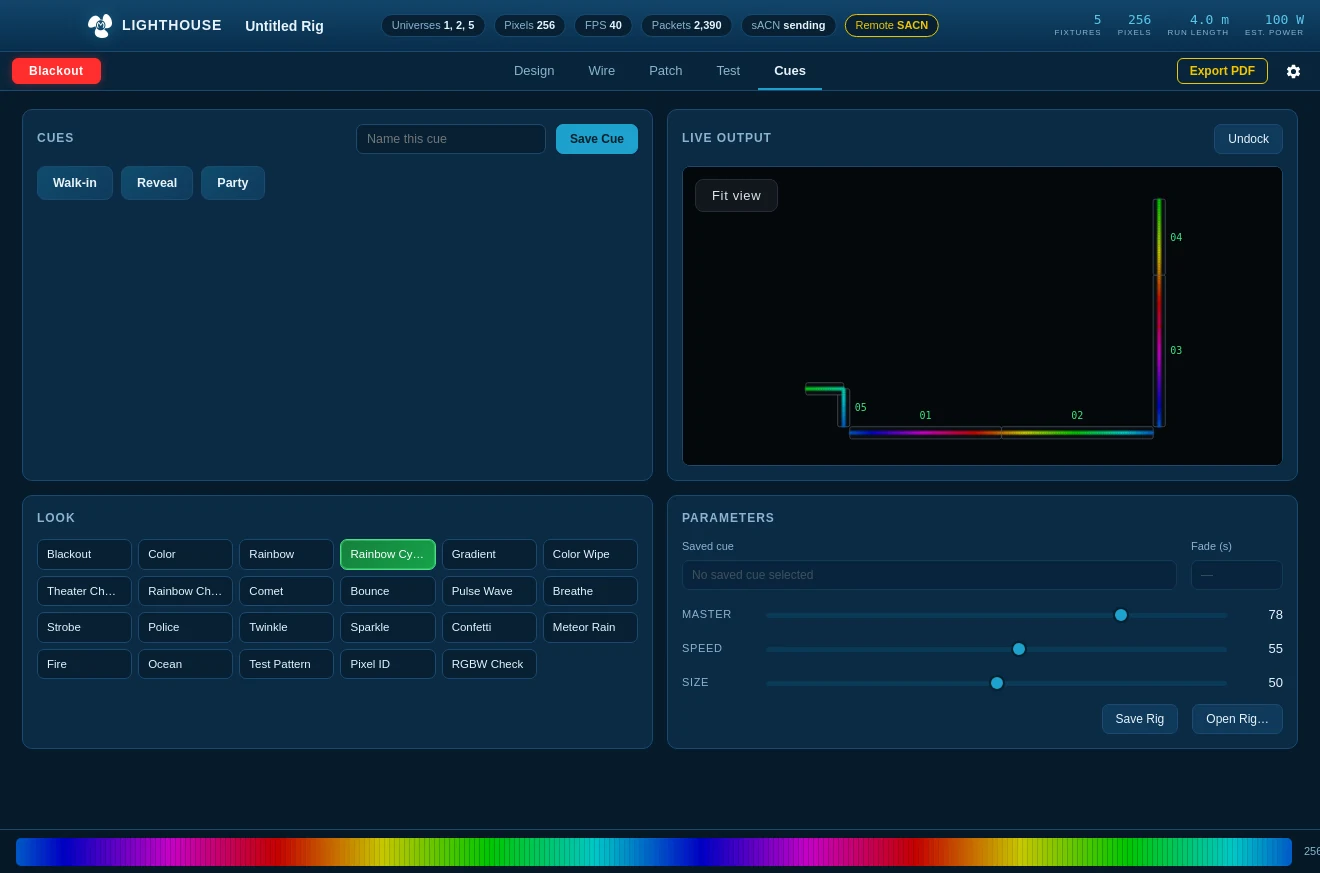
Maritime Lighthouse running a rainbow cycle across a pixel bar rig, with the live output monitor and the saved cue lit green

Works with

All product names, logos and brands are property of their respective owners and are used here to identify compatibility. Art-Net™ Designed by and Copyright Artistic Licence Engineering Ltd.

Draw it · Wire it · Run it

One app, in the order you actually work

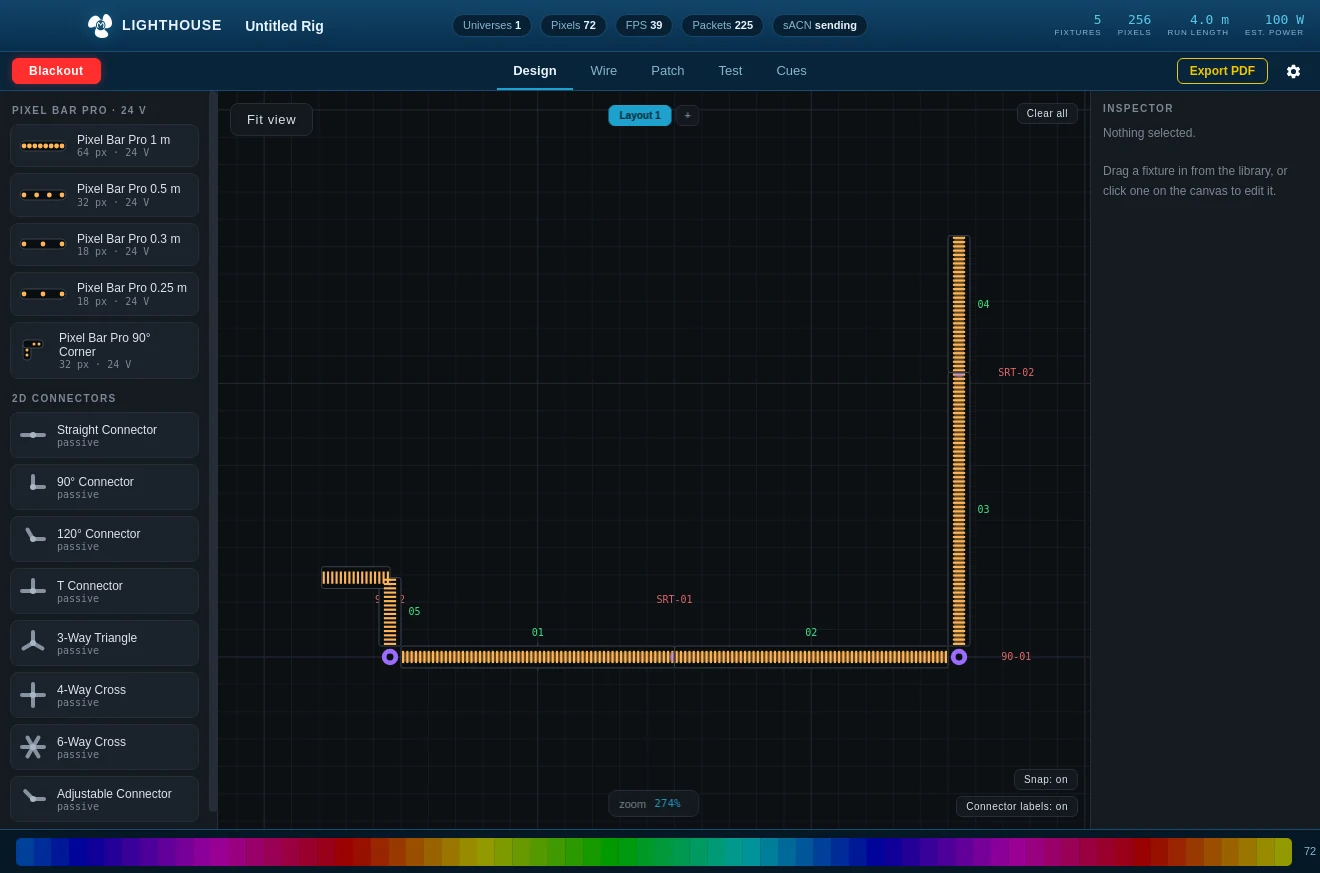
The Design page: an L-shaped run of pixel bars drawn on the canvas with the fixture library on the left

Design

Draw the rig the way it hangs

Pixel bars, corners and connectors snap together on a to-scale canvas. Fit view, layout pages, an inspector for every piece, and a PDF plot for the client or the shop when you are done.

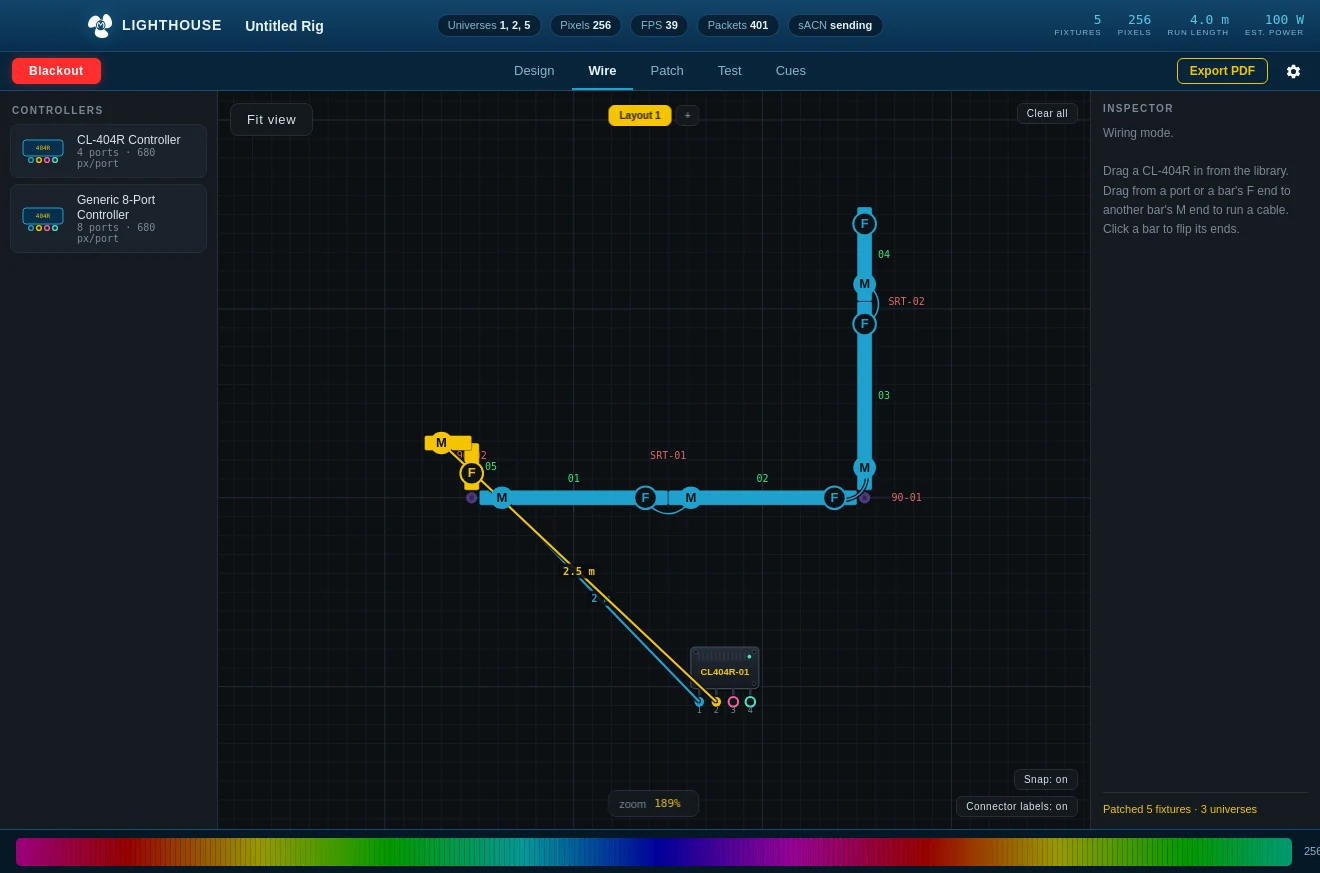
The Wire page: cables running from a CL-404R controller through each bar, colour-coded by port

Wire

Cable it and the patch writes itself

Run cables from controller ports through the bars. Every port shows its pixel and power budget as you go, so a chain that will not work in the truck does not make it onto the plot.

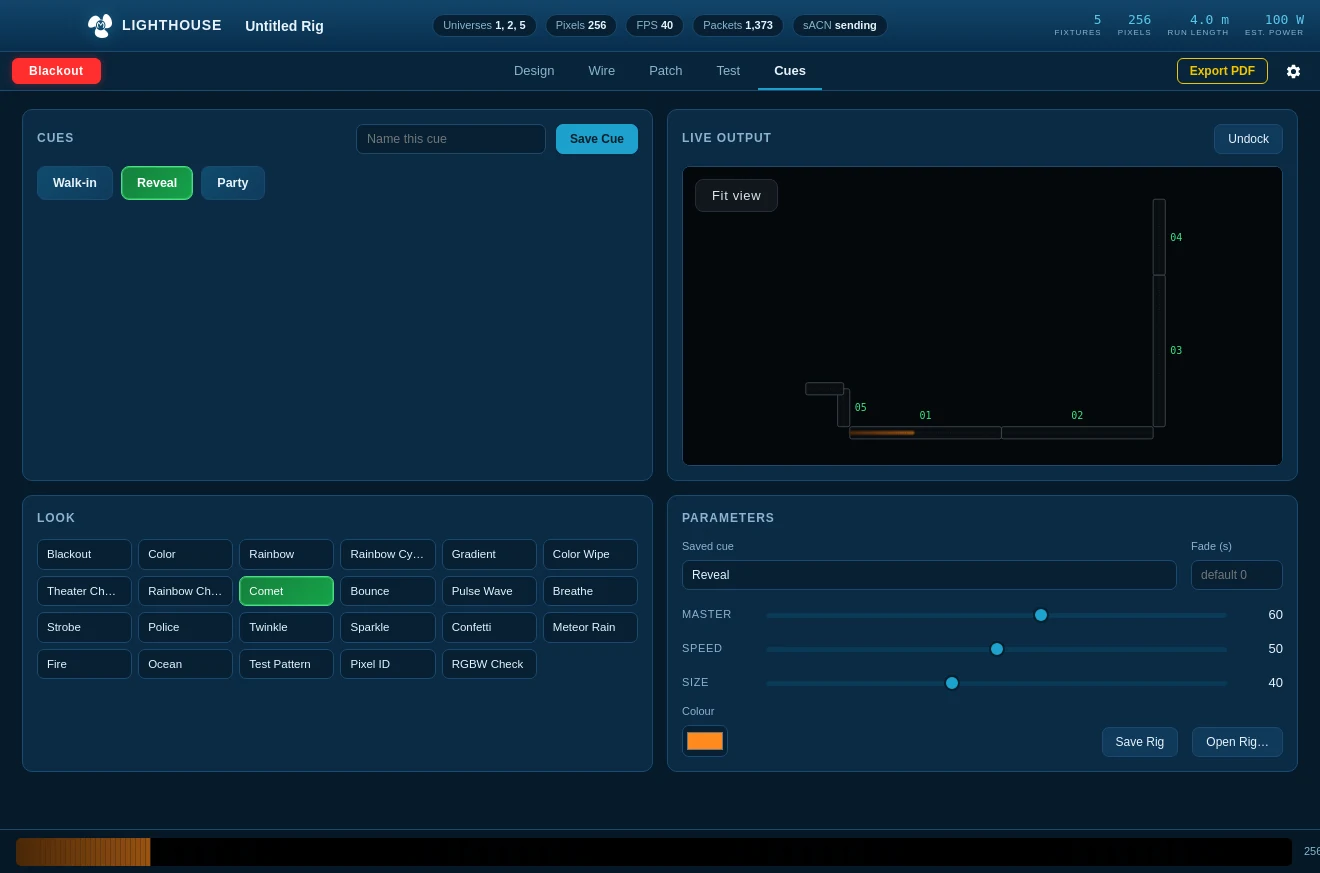
The Cues page: saved cue buttons, the live output monitor, the look grid and the parameter sliders

Cues

Run the show from one page

Twenty-three looks, master, speed, size and colour, and saved cues with their own fade times. Whatever is on stage is green. The live monitor paints every pixel from the frame going out the wire, not a simulation.

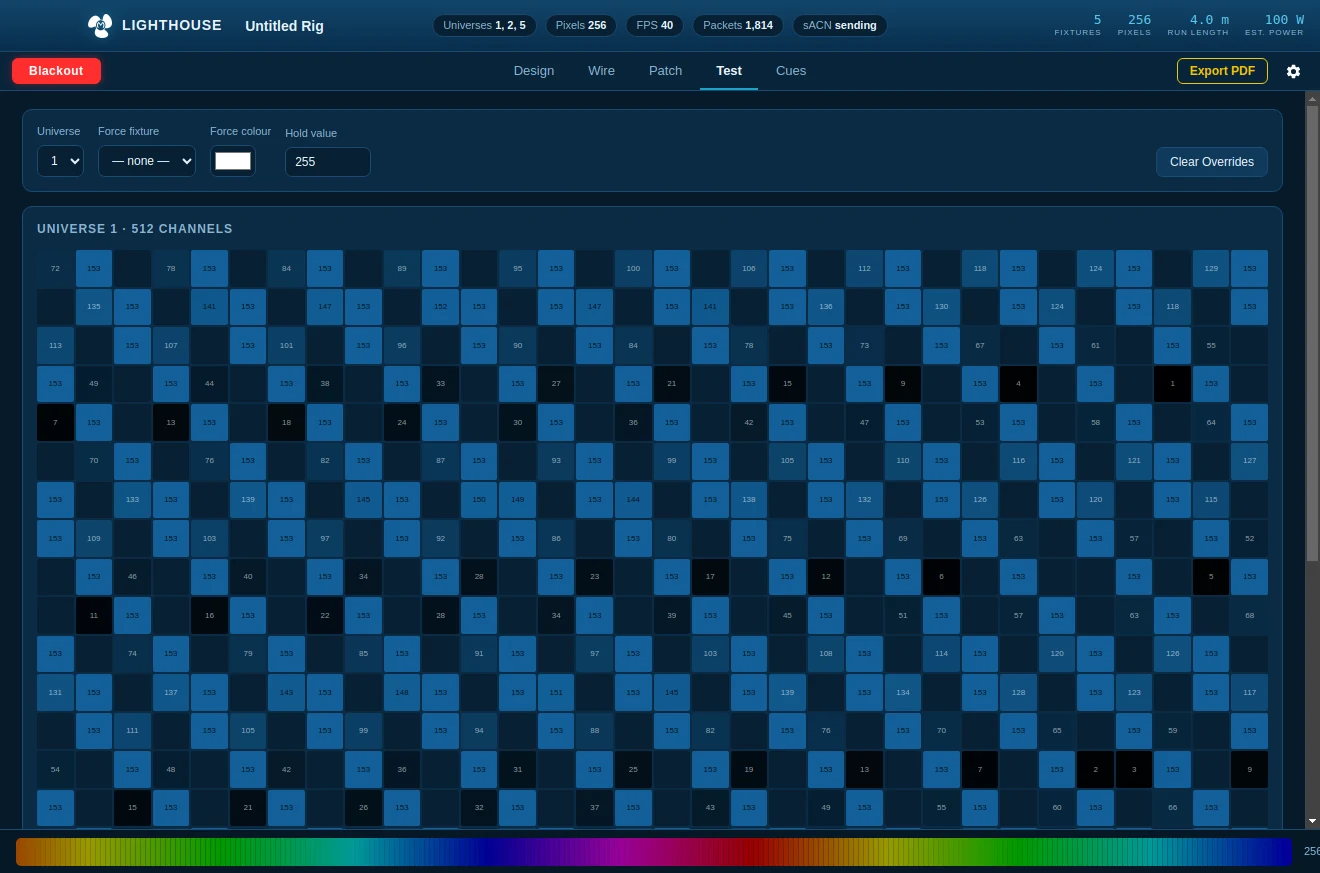
The Test page: a 512-channel grid with live values and the fixture map

Test

Prove the wiring before doors

All 512 channels of any universe, live. Pin a channel, force a fixture to a flat colour, solo one bar white, and read the fixture map underneath to see exactly which channels it owns.

The Cues page while a console holds Lighthouse over sACN, showing the Remote pill in the title bar

Remote

Hand the wheel to a console

Turn on sACN input and a grandMA3 patches Lighthouse as an 11-channel fixture — master, look, cue, speed, size, colour, blackout, fade. A yellow pill says who is in control; drop the control channel and it hands back.

Remote control

Run it from the console, the Stream Deck, or the laptop

Every source goes through one control model, so there is no fighting. Whoever changed the look last, the window shows it — and blackout from anywhere is blackout everywhere.

grandMA3GDTF

A fixture on your console

Patch Lighthouse over sACN as an 11-channel fixture: Master, Look, Saved cue, Speed, Size, RGB, Blackout, Control, Fade. While the console holds the Control channel it owns the levels; let go and the laptop has it back with the last look still running.

Download the GDTF profile →
Bitfocus CompanionElgatoStream Deck

A button for every cue

The Bitfocus Companion module has actions for cues, looks, master, colour and blackout, feedbacks that light the button that is live, and ready-made presets for every saved cue. It follows the app in real time, so a button goes dark the moment the console takes over.

Download the Companion module →
Home Assistant

Anything that speaks HTTP

A plain JSON API on the show LAN: recall a cue by name, set the master, fade, blackout. A Server-Sent Events stream reports every change as it happens. Optional bearer token. Home Assistant, QLab scripts, a show controller — if it can make a request, it can run the rig.

POST /api/preset
{"name": "Walk-in", "fade": 3}
API reference in the manual →

Under the hood

Everything the rig needs, nothing it does not

sACN and Art-Net, both live

Full E1.31 data packets, unicast or multicast, plus ArtDmx — per fixture, so half a rig can sit on each protocol.

A real render engine

23 looks at 40 fps across the whole rig as one continuous strip, so a chase crosses every bar instead of restarting at each one. Every cue crossfades.

Patch that matches the truck

Universe, start address, pixel count, colour order, reverse. Overlapping and over-512 addresses get flagged before you leave the shop.

An output monitor that tells the truth

All 512 channels of any universe, live. Pin a channel, force a fixture to a flat colour, solo one white — prove the wiring instead of guessing at it.

Rigs travel as one file

Drawing, wiring, patch, cues, parameters and network settings save into a single document. Hand it to whoever is running the show.

No server, no broker, no internet

Signed and notarized by Apple, installs with a drag. Put it on a show laptop and it works in an empty building.

Add-ons

The rig designer, inside your media server

Some of Lighthouse is useful even when Lighthouse is not the thing driving the lights. These are free, they stand alone, and they do not need the app installed.

Maritime Pixelmap

for disguise Designerv0.1.0

Draw the rig once. Push the patch straight onto the disguise stage.

Lighthouse's rig designer, packaged as a disguise Designer plugin. Draw the bars, cable them the way they are actually cabled, and it works out the wiring order, the universes and the channels — then creates them on the disguise stage as DmxScreens or DmxLights, positioned where you drew them.

  1. 1Draw the rig and cable it. The patch comes from the real cable chains, not from a spreadsheet.
  2. 2Pick how the drawing sits on stage — a wall seen straight on, or the floor from above.
  3. 3Pick what to create: a DmxScreen per bar, or a DmxLight per controller port.
  4. 4Read the Python it is about to run. Edit it if you want to. Then push.
Download

ZIP · 196 KB · drop into your Plugins folder

You need

  • disguise Designer with a running session
  • The Designer API on its default port 80
  • No other software — the plugin talks to Designer directly

Early release. Two DMX fields are set from disguise's documented example rather than tested hardware, and the plugin shows you the script before it runs so you can correct them. Tell us what your machine wanted.

Got a problem worth writing software for?

We build tools for our own crews first, then hand them to yours. If your show needs something that does not exist yet, tell us what it has to do.